Nearly all of these sit in the tree's traditional layer — the rabbinic genealogies, not the registers — so they come with the salt the note on evidence prescribes, and the pride it permits. They reach me through the family's Ashkenazi (European) lines, not the Iraqi Sassoon side — the line that gave me the name has a page of its own. Relatives nearer the present — and a good deal more famous — are on the famous relatives page. No photographs of the men themselves, naturally: the drawings are artists' imaginings, and where no portrait tradition exists, their graves and monuments stand in. Newest first.
Aharon Shmuel Kaidanover, the Maharshak
13×great-grandfather
Lithuania → Kraków (Poland) · died 1676. A Talmudist whose career maps the century's catastrophes: driven from Vilna (Lithuania) by the wars of 1655, rabbi in Fürth and Frankfurt (Germany), and finally chief rabbi of Kraków. His commentaries on the Talmud's sacrificial orders are still printed in standard editions.
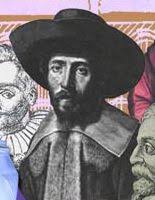
Saul Wahl Katzenellenbogen
13×great-grandfather
Padua (Italy) → Brest (Belarus) · 1541–1617. Financier to the Commonwealth's magnates, patron of Brest's scholars — and, by tradition, king of Poland for a single night. He holds court on the kings & queens page.
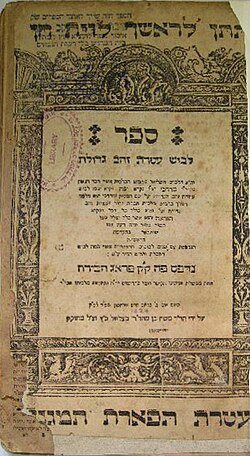
Mordecai Jaffe, the Levush
13×great-grandfather
Prague (Czech Republic) → Poznań (Poland) · 1530–1612. Head of the Prague scholar dynasty this site keeps mentioning. His ten-volume code, the Levushim — 'the garments' — set out Jewish law with its reasons attached, a deliberate middle way between the Shulchan Aruch's brevity and the Talmud's sprawl. Led communities in Prague, Grodno, Lublin and Poznań.
Title page of his Levush Ateret Zahav, printed in Prague in 1624. Public domain, via Wikimedia Commons.
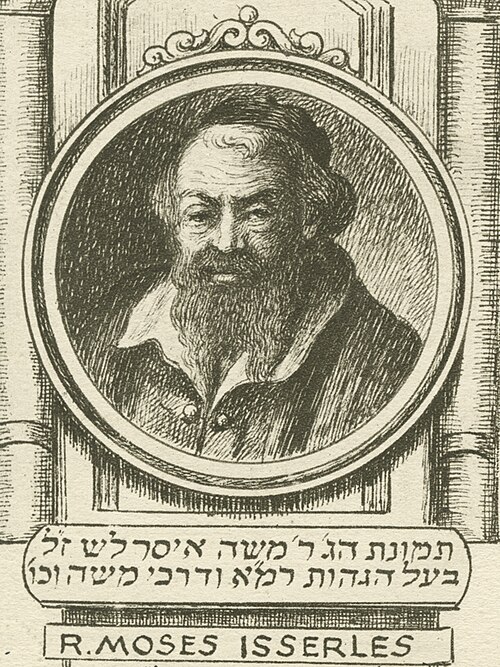
Moses Isserles, the Rema
15×great-grandfather
Kraków (Poland) · c. 1530–1572. The line runs through his daughter Dreizel. When the Sephardi Shulchan Aruch arrived, the Rema laid his Mapah — 'the tablecloth' — of Ashkenazi rulings over it, and the combined work became the law code of European Jewry to this day. His synagogue still stands in Kraków's Kazimierz, with his grave beside it.
Meir Kunstadt, postcard portrait, early 1900s — an artist's imagining. Public domain, via Wikimedia Commons.
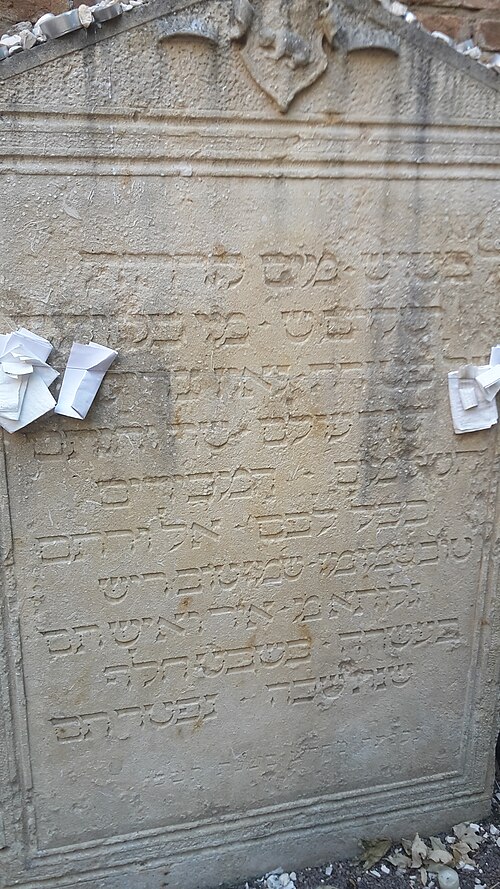
Meir Katzenellenbogen, the Maharam of Padua
14×great-grandfather
Katzenelnbogen (Germany) → Padua (Italy) · 1482–1565. Head of Padua's yeshiva for four decades, consulted by communities from Italy to Poland; his responsa are still cited. Father of Samuel Judah of Venice, grandfather of Saul Wahl — the dynasty whose sons the timeline sends north to the Commonwealth.
His gravestone in Padua's old Jewish cemetery, prayer notes tucked in. Photo: Davidpdv, CC BY-SA 4.0, via Wikimedia Commons.
Matityahu Treves, chief rabbi of Paris
19×great-grandfather
Paris → Marseille (France) · c. 1325–1387. Appointed chief rabbi of Paris after the readmission of 1361, under Charles V — the last great office of medieval French Jewry before the final expulsion of 1394 ended it. By family tradition he finished his days in the south, in Marseille, as the Paris box on the main page remembers.
The Tosafists of Ramerupt & Dampierre
25–28×great-grandfathers
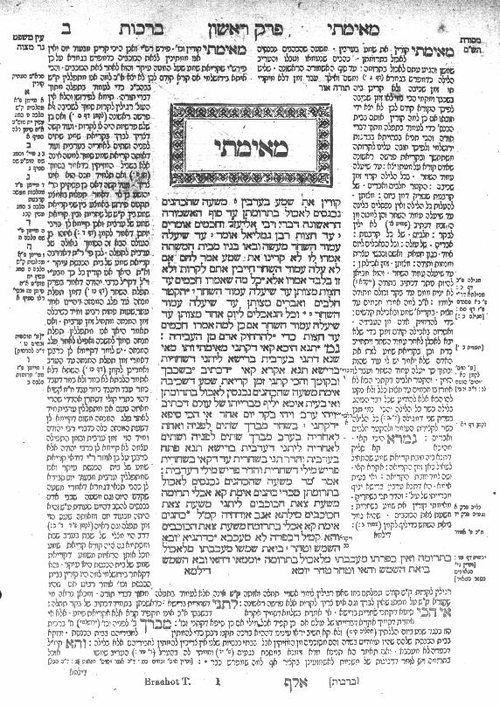
Champagne (France) · 12th century. Three of the school that turned Rashi's commentary into the running argument printed on every Talmud page since: Meir of Ramerupt, Rashi's son-in-law; Isaac the Elder of Dampierre, the Ri, the school's towering master; and Elhanan of Dampierre, the Ri's son, scholar and martyr. The academies the Royal France box calls 'the lamps of medieval Jewish learning' were, in part, their houses.
The first page of the Talmud as it is still printed: the text in the middle, Rashi on the inside, the Tosafists on the outside. Public domain, via Wikimedia Commons.
Simchah of Vitry
28×great-grandfather
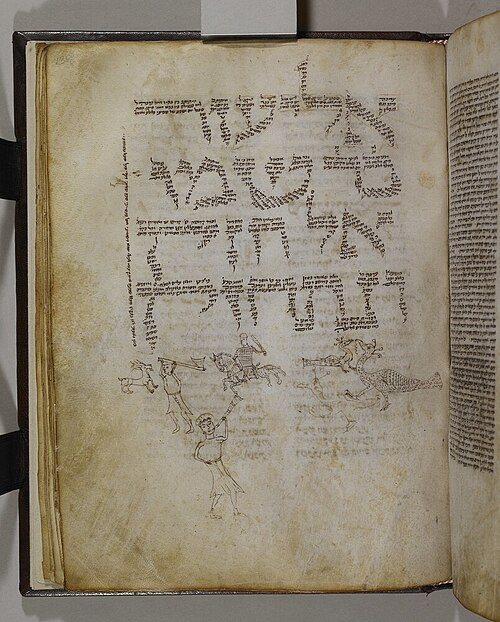
Vitry (France) · died 1105. Rashi's pupil and compiler of the Machzor Vitry, the great early sourcebook of Ashkenazi prayer and custom — the reason historians know how the communities of medieval France actually davened.
A page of his Machzor Vitry in a copy made in France in 1204 (Jewish Theological Seminary, MS 8092). Public domain, via Wikimedia Commons.
Rashi of Troyes
28×great-grandfather
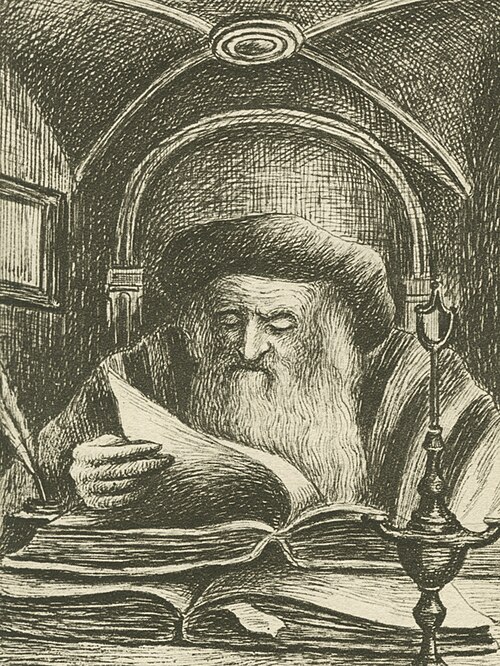
Troyes (France) · 1040–1105. Rabbi Shlomo Yitzchaki — the commentator. His running explanation of the Torah and the Talmud has been printed beside the text itself for nine centuries; a Jewish child's first day of Chumash and a scholar's last page of Talmud both happen in his company. When the timeline speaks of 'Champagne's academies and the great school of Torah commentary', this is the man. The tree carries the line through his daughters — he had no sons, and taught his daughters in an age that rarely did.
Meir Kunstadt, postcard portrait, early 1900s — an artist's imagining. Public domain, via Wikimedia Commons.
Meshulam the Great of Lucca
33×great-grandfather
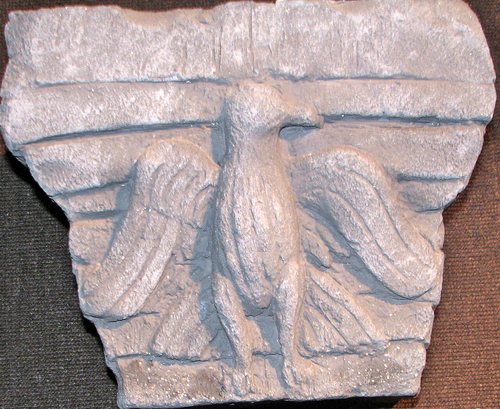
Lucca (Italy) → the Rhineland (Germany) · 10th century. Of the Kalonymos family, the scholar dynasty carried from Italy to Mainz — the seeding event of Rhineland Jewish life, as the Holy Roman Empire box puts it. Liturgical poet; several of his compositions are still said on Yom Kippur.
A column capital from the Kalonymos family's house in Mainz, in a museum copy. Photo: Sodabottle, CC BY-SA 3.0, via Wikimedia Commons.
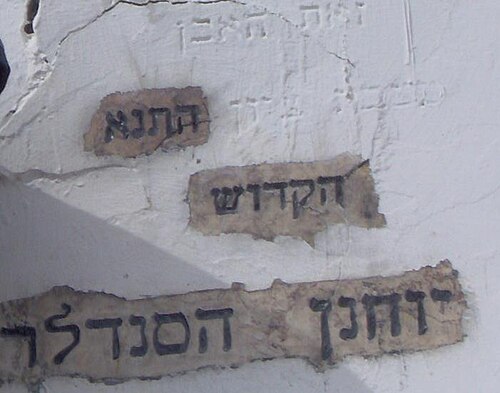
Yochanan HaSandler
65×great-grandfather
Alexandria (Egypt) → Meron (Israel) · 2nd century. Mishnaic sage and sandal-maker — the trade is in the name — of the generation after Bar Kokhba, when scholarship itself was a capital offence. His grave on Mount Meron remains a place of pilgrimage.
The inscription at his grave on Mount Meron: 'the holy Tanna, Yochanan HaSandlar'. Photo: CC BY-SA 2.5, via Wikimedia Commons.
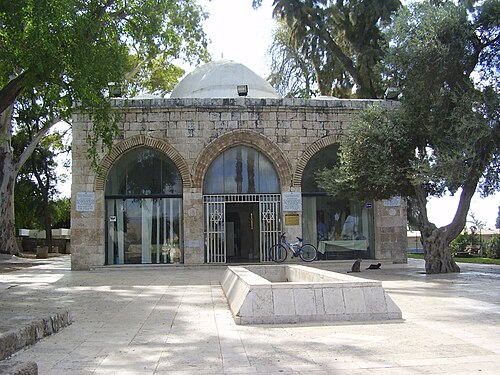
Rabban Gamliel of Yavne
66×great-grandfather
The Galilee → Yavne (Israel) · 1st–2nd century. Head of the council at Yavne that rebuilt Jewish learning after the Temple fell — the pivot on which the whole later story turns, and a man this site has been quietly crediting since its first paragraph.
His tomb in Yavne. Photo: Dr Avishai Teicher, PikiWiki, CC BY 2.5, via Wikimedia Commons.
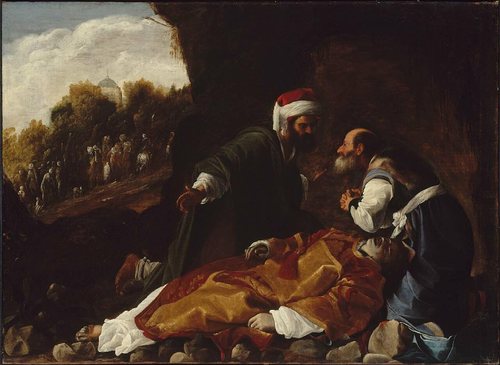
Gamaliel the Elder
68×great-grandfather
Jerusalem (Israel) · 1st century. Hillel's grandson and head of the Sanhedrin in the Temple's last decades — the first sage to carry the title Rabban, 'our master'. He is one of the few rabbis the New Testament names: the Book of Acts has him counsel the court to leave the apostles alone, and Paul claims to have studied at his feet. Which is why the picture is a Christian one.
Carlo Saraceni, 'Saint Stephen Mourned by Saints Gamaliel and Nicodemus', about 1615 — Gamaliel in the red turban, as the Church remembered him. Public domain, via Wikimedia Commons.
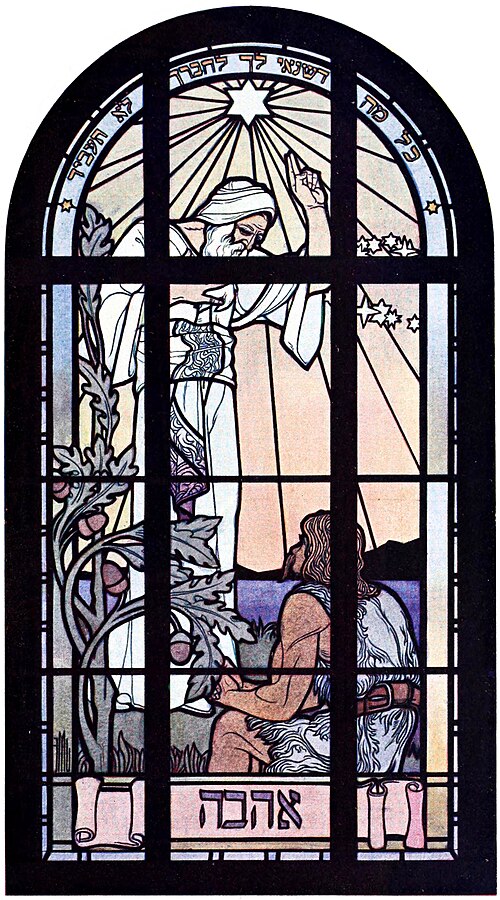
Hillel the Elder
70×great-grandfather
Babylonia (Iraq) → Jerusalem (Israel) · 1st century BCE. The gentle sage of the Second Temple, founder of the house through which the patriarchs descended — and of three questions still doing their work: 'If I am not for myself, who will be for me? If I am only for myself, what am I? And if not now, when?'
Hillel teaching, stained-glass design by E. M. Lilien, before 1925. Public domain, via Wikimedia Commons.
Past Hillel the tree stops following records of any kind. Tradition has his house descend from King David, and from David the line is simply the Bible's own: Ruth, Judah, the patriarchs, Noah, Adam. That is scripture, not genealogy — every family that reaches Hillel on paper inherits the same page — but it is what the tree says, so here it is, with the paintings it has earned over the centuries.
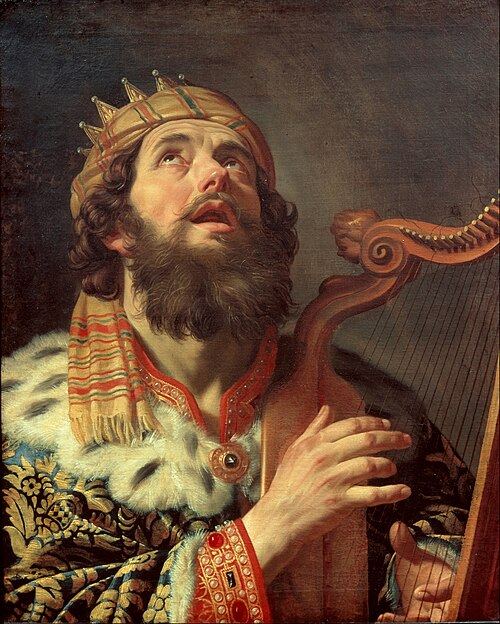
King David
109×great-grandfather
Bethlehem → Jerusalem (Israel) · by tradition around 1000 BCE. Shepherd, harpist, giant-killer, king, and the author the Psalms are credited to. He has a throne on the kings & queens page.
Gerard van Honthorst, 'King David Playing the Harp', 1622 — an artist's imagining. Public domain, via Wikimedia Commons.
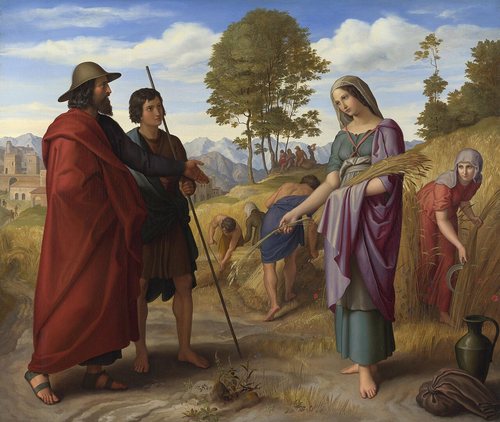
Ruth & Boaz
112×great-grandparents
Moab (Jordan) → Bethlehem (Israel). David's great-grandparents, and the Bible's gentlest book: the Moabite widow who would not leave her mother-in-law — 'where you go, I will go' — and the landowner who noticed her gleaning in his barley.
Julius Schnorr von Carolsfeld, 'Ruth in Boaz's Field', 1828. Public domain, via Wikimedia Commons.
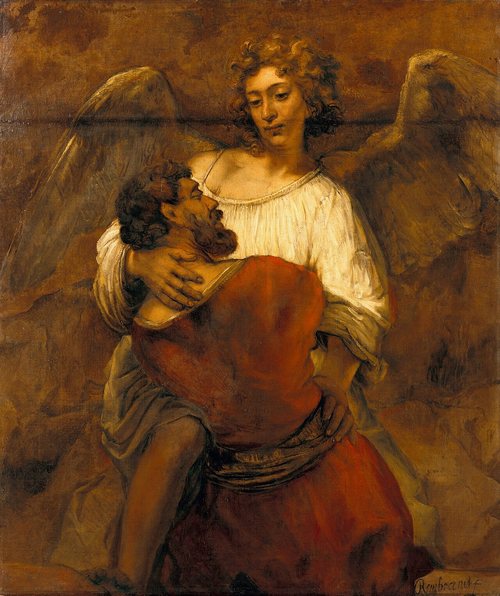
Jacob
127×great-grandfather
Canaan (Israel) → Egypt. The third patriarch, father of the twelve tribes. The tree follows his son Judah and Judah's twins by Tamar. After a night wrestling a stranger at the ford of the Jabbok he was given the name the whole people still carries: Israel.
Rembrandt, 'Jacob Wrestling with the Angel', about 1659. Public domain, via Wikimedia Commons.
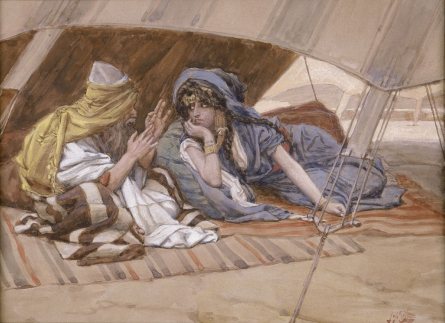
Abraham & Sarah
129×great-grandparents
Ur (Iraq) → Canaan (Israel). The first patriarch and matriarch — which means that, in the tree's telling, both halves of the family begin in Iraq: the Sassoons of Baghdad on one side, and on the other a couple who left Ur some four thousand years earlier.
James Tissot, 'Abram's Counsel to Sarai', about 1896–1902. Public domain, via Wikimedia Commons.
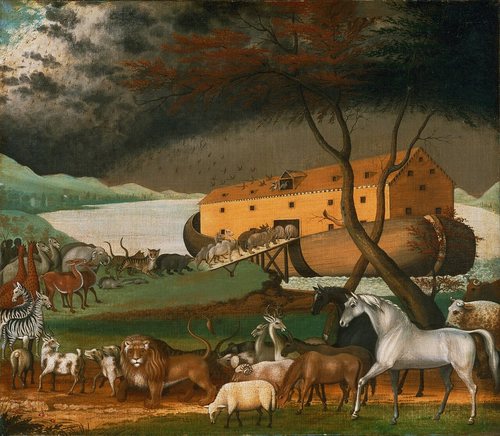
Noah
139×great-grandfather
Before the flood, and after it. Builder of the ark; by the Bible's account everyone alive descends from him, which makes this the least exclusive entry on the page.
Edward Hicks, 'Noah's Ark', 1846. Public domain, via Wikimedia Commons.
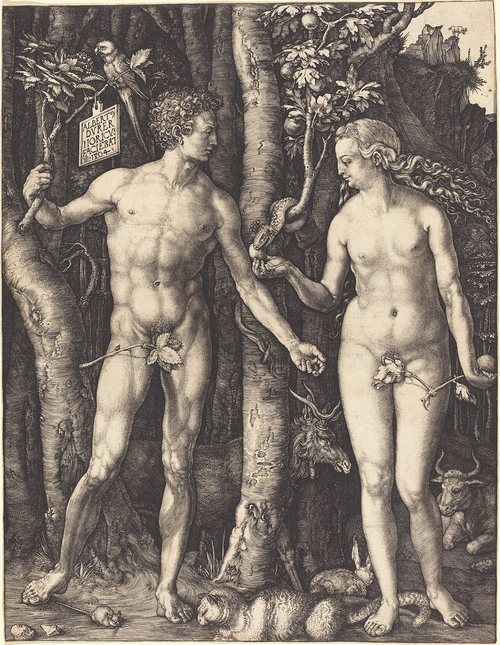
Adam & Eve
148×great-grandparents
Eden. Where the tree, like every tree that goes this far, runs out of parents. A hundred and fifty generations from the garden to here, by its count.
Albrecht Dürer, 'Adam and Eve', engraving, 1504. National Gallery of Art, Washington, CC0, via Wikimedia Commons.